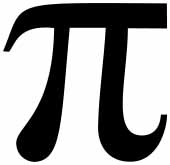

Pi is a mathematical constant whose value is the ratio of any circle's circumference to its diameter in Euclidean space; this is the same value as the ratio of a circle's area to the square of its radius. It is approximately equal to 3.14159265 in the usual decimal notation. Many formulae from mathematics, science, and engineering involve ¹, which makes it one of the most important mathematical constants.
Pi is an irrational number, which means that its value cannot be expressed exactly as a fraction m/n, where m and n are integers. Consequently, its decimal representation never ends or repeats. It is also a transcendental number, which implies, among other things, that no finite sequence of algebraic operations on integers (powers, roots, sums, etc.) can be equal to its value; proving this was a late achievement in mathematical history and a significant result of 19th century German mathematics. Throughout the history of mathematics, there has been much effort to determine ¹ more accurately and to understand its nature; fascination with the number has even carried over into non-mathematical culture.
Probably because of the simplicity of its definition, the concept of ¹ has become entrenched in popular culture to a degree far greater than almost any other mathematical construct. It is, perhaps, the most common ground between mathematicians and non-mathematicians.Reports on the latest, most-precise calculation of Pi (and related stunts) are common news items. The current record for the decimal expansion of ¹, if verified, stands at 5 trillion digits.
The Greek letter ¹, often spelled out pi in text, was first adopted for the number as an abbreviation of the Greek word for perimeter (as an abbreviation for "perimeter/diameter") by William Jones in 1706. The constant is also known as Archimedes' Constant, after Archimedes of Syracuse, although this name is uncommon in modern English-speaking contexts. Pi - Read more

Pi Day: From rockets to cancer research, here's how the number pi is embedded in our lives
PhysOrg - March 15, 2026
Pi is part of "literally every single formula that you would use to do any calculation, like for spacecraft motion, for materials and how they work, or propulsion systems. Anything that is round or has cyclical or repeating properties - such as radio waves - involves pi. Even squares or irregular blobs can be broken down into a series of progressively smaller circles and calculated using pi
Pi Day: Breakthrough Obliterates The World Record For Calculating Pi
Science Alert - March 14, 2026
As Pi Day rolls around for another year, researchers at StorageReview, a leading publication in enterprise IT, have a fitting number to celebrate - A world-record calculation of the mathematical constant (pi) to a mind-boggling but extremely satisfying 314 trillion digits. That's 314,000,000,000,000 decimal places for a number that, according to NASA's Jet Propulsion Laboratory, only needs about 37 decimal places to calculate the circumference of the observable Universe to within the width of a hydrogen atom.
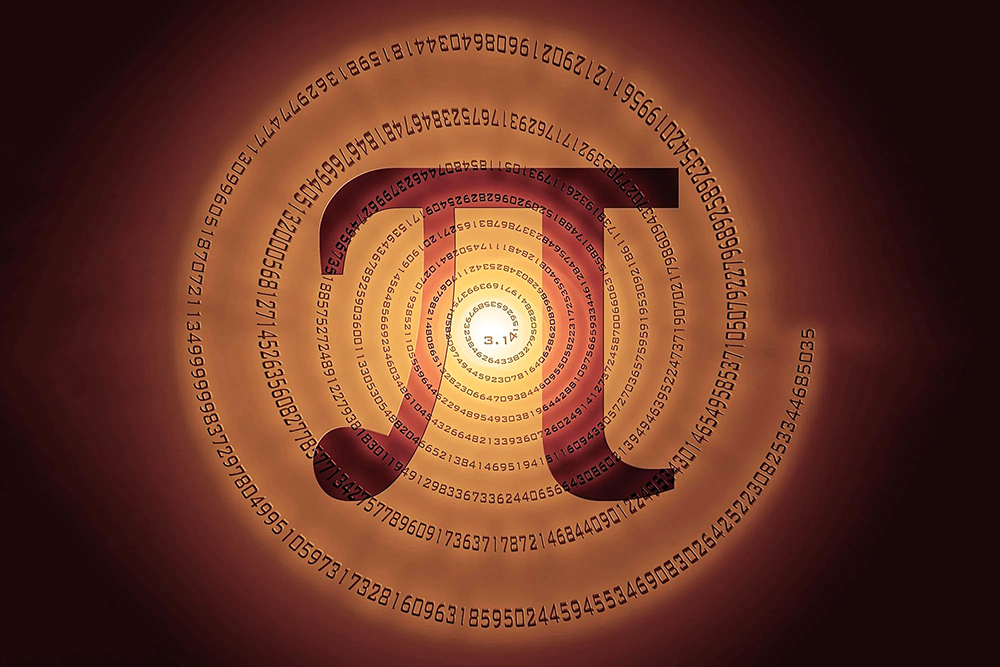
Ramanujan's 100-Year-Old Pi Formula That Hides the Secrets of the Universe.
SciTech Daily - December 8, 2025
A new study reveals that Srinivasa Ramanujan's century-old formulas for calculating pi unexpectedly emerge within modern theories of critical phenomena, turbulence, and black holes. Researchers have shown that some of the purely mathematical formulas created a century ago to calculate pi are closely linked to present-day fundamental physics. These old formulas reappear in theoretical models used to study percolation, turbulence, and certain aspects of black holes.
Pi calculated to a record-breaking 62.8 trillion digits
Live Science - October 8, 2021
Supercomputer took 108 days to run the calculations. Researchers in Switzerland are set to break the record for the most precise value of the mathematical constant pi, after using a supercomputer to calculate the famous number to its first 62.8 trillion decimal places.Pi is the ratio of a circle's circumference to its diameter. The name "pi" comes from the 16th letter in the Greek alphabet and has been used by mathematicians to represent the constant since the early 18th century. The first 10 digits of pi are 3.141592653, but the constant is what is known as an irrational number, meaning that it cannot be expressed as a common fraction and has an infinite number of decimal places.